Showing posts with label Metro Manila. Show all posts

Tuesday, September 14, 2010

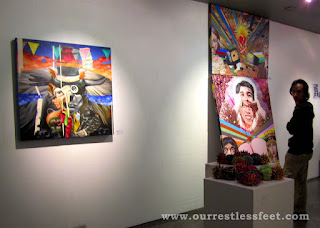
Mag:net Gallery - Day to Day Prime Time Ecstasy Exhibit

WHERE: Mag:net Gallery, Katipunan Avenue, Quezon City
EXHIBIT DATES: September 4 to 30, 2010

WHY YOU SHOULD GO:
1. Because it showcases the talent of upcoming young Filipino artists. :)

FEES: Free entrance but you can buy any of the works in the exhibit

NOTE: Mag:net Gallery changes their art exhibits monthly.


DESCRIPTION:
Mag:net Cafe & Gallery
Mag:net Cafe is an artist haven. It supports a lot of Philippine contemporary arts from visual arts to literature to music. It has a gallery which showcases different exhibits every month and a cafe that serves salads, appetizers, soups, sandwiches, pasta, desserts, merienda and "real" meals. It also serves as a venue for film screenings, performances, literary readings, impromptus, jamming sessions and other art-related events. It is open from Mondays to Saturdays from 10am-7pm.


Day to Day Prime Time Ecstacy
(mostly copied from the handout of mag:net gallery)
The television is a part of Filipinos' everyday lives. Local channels like ABS-CBN , TV5 and GMA offer cartoons, commercials, noon time shows, current news and events, showbiz buzz, talk shows, talent shows, telenovelas, koreanovelas, teleseryes and more. With everyday viewing of these shows, its influences are inevitable to Filipino culture. These shows continually establish cultural trends and are usually successful in hypnotizing its viewers to agree and operate accordingly with the culture they are secretly imposing. The influence they enforce on Filipinos is manifested through the prevailing characteristics of our society's culture such as being elitist, westernized, escapist, fetishist and having a dog-eat-dog mentality.

With all these nonsense on television and with the culture as described above that these nonsense and fetish television shows communicate to its viewers every hour of everyday, it is constantly able to show the "ecstacy" of the real. The people, rather than just watching the shows, begin to actually live the "ecstacy" which is actually very ironic and problematic since the reality on TV and the one we are actually living are quite different. Popularity has become more important than content and quality and romanticism of reality is applauded.

The television, being a tool for advertisers, for show business and their biases, for entertainers who suck blood and life from the viewers is an ideological state apparatus to may be likened to the church and the academe. Its power of communication over its viewers is one-sided most of the time.

Now for the local channels to be acknowledged, their shows need to be "sellable", and to do this, they would have to romanticize and exoticize reality. They distort the reality in order to sell. They show what they want people to see, whether or not it's reflective of real life.

This exhibit focuses on the ecstacy of the real inculcated on by television shows, to depict and question the culture these variety shows infuse on each individual who watches television and challenge the present ideology accepted and oftentimes overlooked. The subliminal messages of television shows and how it hypnotizes its viewers' minds that lead to our decadent trying-hard-to-be Hollywood celebrities/ rockstars/ artstars will be represented in different approaches according to each artist and hopefully be of contribution in displaying and documenting this kind of culture. After all, the most common of everyday life are the ones that say many things about the society's thinking.

The works range from two-dimensional paintings to three-dimensional sculptural pieces and installations. In two-dimensional works, mixed media and paintings are exhibited while in three-dimensional works, both molded sculptural pieces and asssemblages of ready-mades are exhibited.

This exhibit will run until September 30, 2010.

HOW TO GET THERE:
From the University of the Philippines Diliman, take a jeep going to Katipunan (P7.00). You can also take the LRT (Light Rail Transit) and go down at the Katipunan Station. From there, take a tricycle to mag:net cafe for P25.00. It is right beside Rustan's Supermarket.


CONTACTS: +632 9293191 info@magnetgalleries.com

LIST OF ARTISTS AND THEIR WORK/S:


Buen Abrigo
Ang Araw-araw na Aparisyon ng mga Dyos na Puta sa Bawat Kahon na May Cablewire at Antenna (dyptich)
2010
Acrylic and Collage on Canvas
108 x 48 inches
Price: P113,700.00 (48 x 72)/ P56,850.00 (36 x 48)


Dean Africa
These Selfish People
2010
Oil on Wood Panel
24 x 48 inches
Price: P10,600.00


Dean Africa
Variations on Kuya Germs
2010
Colored Pencil on Paper/ Size variable
Price: P820.00 (each)


Beatrica Alcala
Director Predator Series (multiples)
2010
Acrylic on Resin, Size variable
Price: P45,500.00 (8 pieces)/ P5,700.00 (each)


Carlo De Guzman
My Bigot Tih
2010
Oil on Canvas
36 x 36 inches
Price: P16,300.00


Mity Dela Pena
Over Lowed
2010
Collage - Acrylic, Latex and Ink on
Discarded Refrigerator Packaging
24 x 60 inches
Price: P12,200.00


Frank Magalona
Life in Technicolor (Information Overload) R,G,B series and Viewer no. 23, 639, 014
2010
Spraypaint on Multi-cast Resin, TV size variables
Price: P58,500.00 (3 pieces)/ P19,500.00 (each)


Jed Nacabuan
The Squash-Head Projectile Theory (Viewers Demise)
2010
Acrylic on Paper and Wood
36 x 36 inches
Price: P16,300.00


Jed Nacabuan
Supahstah
2010
Mixed Media, Size variable
Price: P13,000.00


Veronica Pee
Eat Me
2010
Bread, Paint, Microwave Container/ Size variable
Price: P13,000 (16 pieces)/ P820.00 (each)

Click here for more...

Monday, August 30, 2010

Pan de Amerikana, Marikina City


WHERE: Pan de Amerikana, Marikina City

DATE OF TRAVEL: August 28, 2010

WHY YOU SHOULD GO:
1. Even if you're not addicted to chess, this is such a cool idea! A cafe and chess place rolled into one! They have large chess pieces as well as small ones that you can admire and play with!

2. Their pandesal (bread of salt) is good!

DESCRIPTION:
The owner of Pan de Amerikana is Dionisio Salvador Jr. and his yummy pandesals were taken after his father's recipe! His father was a baker in the 1950's and the size of the pandesals now are huge because that was supposedly the size of the pandesals back then! Obviously owner by a chess lover, the cafe is filled with chess tables and chess pieces may be borrowed from the counter. A collection of the different kinds of chess boards are on display, too! Moreover, Pan de Amerikana is also famouo for its huge chess pieces that both children and adults love playing with. It is also a cafe that is built by someone with love for the arts. Things like broken plates and glasses serve as part of the floor's decoration, the order numbers are put on colorful fans, children's artworks are on display, Mr. Salvador's son's photography works are on display and other arts and cultural stuff such as small trinkets, souvenirs, collections and pictures of the "old" Philippines may be seen all over the restaurant. Free Taichi and Art Lessons are held here as well as photography meetings and sessions. Events like baptism and weddings may be held here, too.

ADDRESS:
92 Ordonez Conception Dos, Marikina City

CONTACTS:
Pan de Amerikana - +632 4752398/ +632 5021361/ +63922 8418824/ +63917 5308824

SCHEDULE:
Restaurant
Mondays to Saturdays: 6:00 am - 6:00 pm
Sundays 7:00 am - 3:00 pm

Bakery
Mondays to Saturdays: 6:00 am- 8:00 pm or until supplies last
Sundays: 5:00 am - 3:00 pm or until supplies last


VEGETARIAN EXPERIENCE:
There's not much to eat here if you're vegetarian, but it's still a cool place to hang out. We just ordered their famous Pan de Sal (bread of salt) and Sago Con Yelo (banana with milk and ice). You can also order omelet but they only serve it during breakfast hours. The prices are very affordable.

PRICES OF OUR ORDER:
Pan de Sal - P5.50 each
Iced Tea - P15.00
Sago Con Yelo - P20.00
Mango Shake - P25.00

Click here for more...

Cafe Kapitan (Sentrong Pangkultura ng Marikina) and Around


WHERE: Sentrong Pangkultura ng Marikina, JP Rizal Street, Sta. Elena, Marikina City
DATE OF TRAVEL: August 28, 2010

WHY YOU SHOULD GO:
1. It was the house of Don Laureano Guvera (more commonly known as Kapitan Moy), the founder of Marikina's shoe business.

2. Shoemaking was made in Kapitan Moy's house, therefore, it was also the first shoe house of Marikina.

3. It is a 200-year old house that definitely has a lot of history. It was not only the first shoe house nor the house of the person who gave birth to the shoe industry in Marikina; it also became a place for the underprivileged and poor residents of Marikina. Dona Teresa dela Paz bought the house from Kapitan Moy and turned it into a place to serve the needs of the marginal sector of the community. It also became a primary school!

FEES: None, but there are two restaurants inside: Cafe Kapitan Restaurant and Cocina

TRIVIA:

1. Kapitan Moy supposedly discovered the art of shoemaking by buying a pair of leather shoes from Europe and did reverse engineering. :)

2. The two people in the statue in front of Plaza Kapitan are Kapitan Moy and Tiburcio Eustaquio.

3. Early in 1993, Mayor Bayani F. Fernando met with the officers of the Marikina Valley Heritage Foundation, Inc. and the Historical Zone Commitee in 1995 to restore this house and make it a place for culture and the arts. An ordinance was passed by the Municipal Council renaming the place "Sentrong Pangkultura ng Marikina".

DESCRIPTION:
Cafe Kapitan is a 200 year old house that belonged to the Guevara Family. Don Laureano, the son of Jose Emiterio Guevara and Matea Mariquita started the shoemaking business here in 1887 with the help of Tiburcio Eustaquio, Ambrocio Sta. Ines and Hervacio Carlos. Don Laureano thought of making shoes as a response to the reality that not all men had interest in farming and a lot of people didn't have jobs. He didn't want to see his countrymen being idle and doing nothing. With a pair of shoes brought home from Europe, he opened the shoe part by part and discovered how it was made. This began the shoe business in Marikina that is now what it is known for.

Cafe Kapitan now houses two restaurants: Cafe Kapitan Restaurant and Cocina. It is also a venue for seminars, conventions and other events. The Bulwagang Bayani, located on the 2nd floor, is fully air-conditioned and can house 400-450 guests. The Plaza Kapitan may also be rented for different occasions.

ADDRESS: J.P. Rizal Street, Sta. Elena, Marikina City

CONTACTS:
Cafe Kapitan Restaurant - +632 6464303
Cultural Affairs Office - +632 6461823/ +632 6462360 local 221/ info@marikina.gov.ph/ http://www.marikina.gov.ph

VEGETARIAN FOOD:
We tried Cafe Kapitan Restaurant and ordered the following:
Garlic Mushroom (good for two) - P125
Garlic Rice - P35
Iced Tea - P48
Coke - P38
There are other (few) vegetarian food you can order such as bread, french fries and egg.


TIP:
If you're already in Cafe Kapitan, might as well walk around the area to see other interesting places. Right beside Cafe Kapitan on JP Rizal street is an old house owned by the Piquintos. Right across this house is another beautiful old house (JP Rizal corner Kapitan Moy). Walk along Kapitan Moy and you will see Our Lady of the Abandoned Parish Cemetery on your left. Go inside to see a nice mausoleum and a basketball court in the middle of the gravestones. There's also a bird house here so expect to see pigeons resting or hanging out. ;) Once you're done, head back to JP Rizal Street and cross to the other side of Cafe Kapitan. It's a narrow street (where a beautiful yellow and red old house stands) that is said to be one of the first settlements of the Marikina people since it is near the riverbank. This street makes you feel like you're back in time. When you're done appreciating the small details of the houses and the narrow alleys, go back to the patio of Cafe Kapitan and walk straight to the Shoe Museum (in Isabelo Street). Once you're done adoring the shoes, you can say a little prayer in the church nearby or eat at our friend's yummy restaurant in Isabelo Street called Isabelo's Garden Restaurant! This restaurant is only by reservation so make sure to call ahead of time. :)

Click here for more...

Sunday, August 29, 2010

Jesus De La Pena Church, Marikina City


WHERE: Jesus De La Pena Church, Marikina City
DATE OF TRAVEL: August 28, 2010
WHY YOU SHOULD GO:
1. It is the oldest church in Marikina City.
2. The first mass in Marikina was held here.

FEES: None

NOTE: This church was obviously restored. The inside, according to our friend who used to hear mass here, looked pretty much like the facade of the church. It isn't like that now today.

DESCRIPTION:
The Jesus Dela Pena Church is the very first church in Marikina City and the first mass was held here because the Jesuit missionaries supposedly saw an image of Jesus in a cliff somewhere in this area. Then a storage room, a church was built on this site on April 16, 1630 with the permission of Father Pedro de Arce, then archbishop of Manila.

ADDRESS: Zamora Street, Barangay Jesus Dela Pena, Marikina City

Click here for more...

Blind Massage Site, Marikina Riverbanks


WHERE: Blind Massage Site, Marikina Riverbanks, Marikina City

DATE OF TRAVEL: August 28, 2010

WHY YOU SHOULD GO:
1. It's cheap and good massage!
2. We get to help the blind people by providing them with jobs.

FEES: P90 for 30 minutes, P180 for an hour

NOTE:
1. If you give P100 or P200 bills, they will not give you change anymore.

DESCRIPTION:

This massage site is actually a small room filled with monoblocks and blind massage therapists. They are trained by the Blind Luzvimin Livelihood Program. For P180, (plus tip) you get an hour massage (head, arms, legs and back) while seated on a monoblock. Comfortable beds with dim lighting must not be expected here, but if you're looking for a good massage after a tiring day, this is just as perfect.

LOCATION:

It's right by the door of Marikina Riverbanks Mall's covered parking (Parking is P25.00 - flat rate). It's near Off Price Mart.

CONTACTS: +63922 698 2649

Click here for more...

World's Largest Pair of Shoes, Marikina


WHERE: At the Marikina Shoe Gallery of Riverbanks Mall, Marikina City, Metro Manila
DATE OF TRAVEL: August 28, 2010

WHY YOU SHOULD GO:
1. It is officially recognized by the Guinness Book of World Records as the largest pair of shoes in the world and it right here in the Philippines!

FEES:
Free

TRIVIA:
1. During the Ondoy typhoon in Metro Manila (September 26, 2009), this pair of shoes "swam" out of the window. Good thing the shoes didn't go straight to the Marikina river!
2. The design of the shoes is patterned after the pair of shoes that Don Laureano Guevarra (more commonly known as Kapitan Moy) brought home from Europe. This is pair that is "responsible" for the birth of Marikina's shoe industry because Kapitan Moy supposedly studied this pair through reverse engineering and began making shoes.

DESCRIPTION:
The shoes measure 529 centimeters long and 327 centimeters wide. It is made of genuine leather and it can fit 30 people inside! Built in 2002, it took 77 days to make the pair. The materials used for this pair can actually make 250 regular-sized shoes.

HOW TO GET THERE:
Just go to Marikina Riverbanks and head the Riverbanks Mall. It is right inside the Marikina Shoe Gallery.

Marikina City is near Quezon City, Pasig City and Antipolo City.

Click here for more...

Monday, February 5, 2007

Star City, Manila


WHERE: Star City, Manila
DATE OF TRAVEL: February 4, 2007
WHY YOU SHOULD GO:
FEES:
NOTE:

DESCRIPTION:
HOW TO GET THERE:
CONTACTS:
HELPFUL LINKS:
PERSONAL EXPERIENCE:

Click here for more...

Friday, November 10, 2006

Ayala Museum, Makati City


WHERE: Ayala Museum, Makati City

DATE OF TRAVEL: November 8, 2006
WHY YOU SHOULD GO:
1) Although a bit pricey especially for locals, it is one of the best museums in the country.
2) Their DIORAMA EXPERIENCE section is a MUST-SEE!
3) Their CROSSROADS OF CIVILIZATION is also a MUST-SEE!
FEES:
Local Residents: P150 up to 3rd floor, P225 with 4th floor galleries (you should include this!)
Local Residents (student, child, senior citizen): P75 (up to 3rd floor), P125 (with 4th floor)
Non-Residents: P350 up to 3rd floor, P425 with 4th floor galleries
Non-Residents (student, child, senior citizen): P250 (up to 3rd floor), P300 (with 4th floor)
MUSEUM HOURS: Tuesday to Friday: 9am-6pm, Saturday-Sunday: 10am-7pm, Monday: closed
NOTE: Picture-taking is not allowed at all. :(


DESCRIPTION:
(from Ayala Museum's website)

Envisioned in the late 1950's by the late artist Fernando Zobel de Ayala y Montojo, Ayala Museum became a reality in 1967 as a project of the Ayala Foundation, Inc. (then known as Filipinas Founation) The museum's first home was in the Insular Life Building along Ayala Avenue. In 1974, the first Ayala Museum building on Makati Avenue, designed by the late National Artist for Architecture, Leandro V. Locsin, was inaugurated. The museum's current building on the corner of Dela Rosa Street was formally dedicated on September 28, 2004. It was Ayala's gift to the Filipino people in celebration of the Ayala Corporations 170th anniversary. Led by Leandro V. Locsin, the museum was designed by the architectural firm Leandro V. Locsin and Partners.

Forming the core of the museum's historical collections are 60 handcrafted dioramas that chronicle the rich tapestry of Philippine History. Ayala Museum also features a one-of-a-kind boat gallery showcasing miniatures of some of the watercrafts that contributed to the development of Philippine Maritime Trade and Colonial Economy. Archaeological and ethnographic objects from the country's northern and southern cultural communities complement the historical collection. The Fine Arts Collection features important works by three painters considered pioneers in Philippine Art: Juan Luna, Fernando Amorsolo and Fernando Zobel.

HOW TO GET THERE:
CONTACTS:
Makati Avenue corner Dela Rosa Street, Makati City, Philippines,
+632 7577117-21
museum_inquiry@ayalamuseum.org

HELPFUL LINKS: http://www.ayalamuseum.org

THINGS WE LEARNED FROM THE CROSSROADS OF CIVILIZATIONS GALLERY:

1. Lakan Bakod is the Tagalog's God of Harvest. It is carved like a human with golden eyes, teeth and a gilt genitalia as large as a rice stalk.

2. In many cultures, GOLD is linked conceptually to spirituality. It is prized for its purity and coveted for its scarcity. Thus, a person who has gold was believed to have supernatural protection and therefore commanded respect and affirmed powers and prosperity.

3. The Boxer Codex (1595) is a manuscript acquired by American professor Charles Boxer which describes the peoples, manners, customs and lifestyle of Asia. Although the author is unknown, the watercolor illustrations are believed to have been done by a Chinese artist. The codex defines Filipinos prior to the coming of the Spanish. It includes 75 colored illustrations of the inhabitants of the places like Siam, New Guinea, Molluccas, Annam, Formosa, Cambodia, Brunei, China, Taiwan and the Philippines. Of the 75, 15 illustrations were dedicated to the Philippines. The Boxer Codex is believed to be the first actual representation of Filipino groups. The Boxer Codex was discovered in 1947 and translated to English in 1958.

4. On 27 April 1981, a heavy machinery operator working on an irrigation project in Surigao noticed partially-buried golden objects scattered along a 100-m stretch of landfill quarried from a nearby mountain in Barrio Magroyong, San Miguel. In the next 7 hours, he recovered several bangles and leg rings of hammered and twisted gold wires, etc. Shortly after this discovery came an influx of treasure hunters who came all the way to Mindanao for what is now called the SURIGAO TREASURE. Of these treasures, one of the most intriguing would be the GOLD REGALLA, a gold chain weighing almost 4 kg which is believed to have been a sacred thread. Some historians believe that this gold chain is an UPAVITA, an important cord used in Hindu purification rituals and only members of the elite Brahmin class were entitled to wear it. (see picture below. picture from this site)


5. Butuan City in Agusan del Norte was the first Philippine State to establish diplomatic relations with China. They had direct contact with the Champas as early as the 10th century. Like other cultures, Butuan's people believed that spiritual forces traveled in and out of the body through fontanels or facial orifices such as the eyes, nose and mouth. To avoid malignant spirits from taking over the dead bodies, they came up with their ingenious funerary face masks made out of gold! Depending on the family's rank and economic means, sheets of gold covered the eyes, nose, mouth or entire face. Diadems of gold sheets adorned the forehead which marked one's elite status (see pic below: pic from this site)


6. Gold was widely known and very common in this country that a 16th century account says that even children could accurately determine s, gold's purity. Bislig means 12 karats, Linggingin means 14 karats, Panangbo means less than 20 karats, Hilapo (which also means to wipe the face) means 20 karats, Ginugulan (which literally means purified) means 22 karats, Dalisay means 24 karats and Tumbaga means less than 12 karats.

OUR FAVORITE LETRAS Y FIGURAS:

Jose Honorato Lozano's LETRAS Y FIGURAS are visual chronicles of Lozano's era and traces its origins to the artful embellishment of the first letters of the chapters of the Bible in the middle ages.

* BURIAL OF A CHILD (Entierro De Un Parbulo) - Far from the solemn ways of the Westerners, the early Filipinos observed the death of a family members with much color and preparation. The most notable one would be the burial of an infant. The dead child was dressed in the costume of a bishop or saint and was mounted on a stretcher in an upright position. Men dressed in colorful attire carried the stretcher to the cemetery with the family of the deceased behind them. At the head of the procession was a band of musicians playing music all the way.

* NATIVES CARRYING HAMMOCK (Indios Llevando Hamacas) - A popular way to travel in the mountains was by riding on a hammock. 8 men would carry the hammock (4 at a time) and the person inside sat on a bedroll and pillow. The hammock was covered with a tent.

Click here for more...